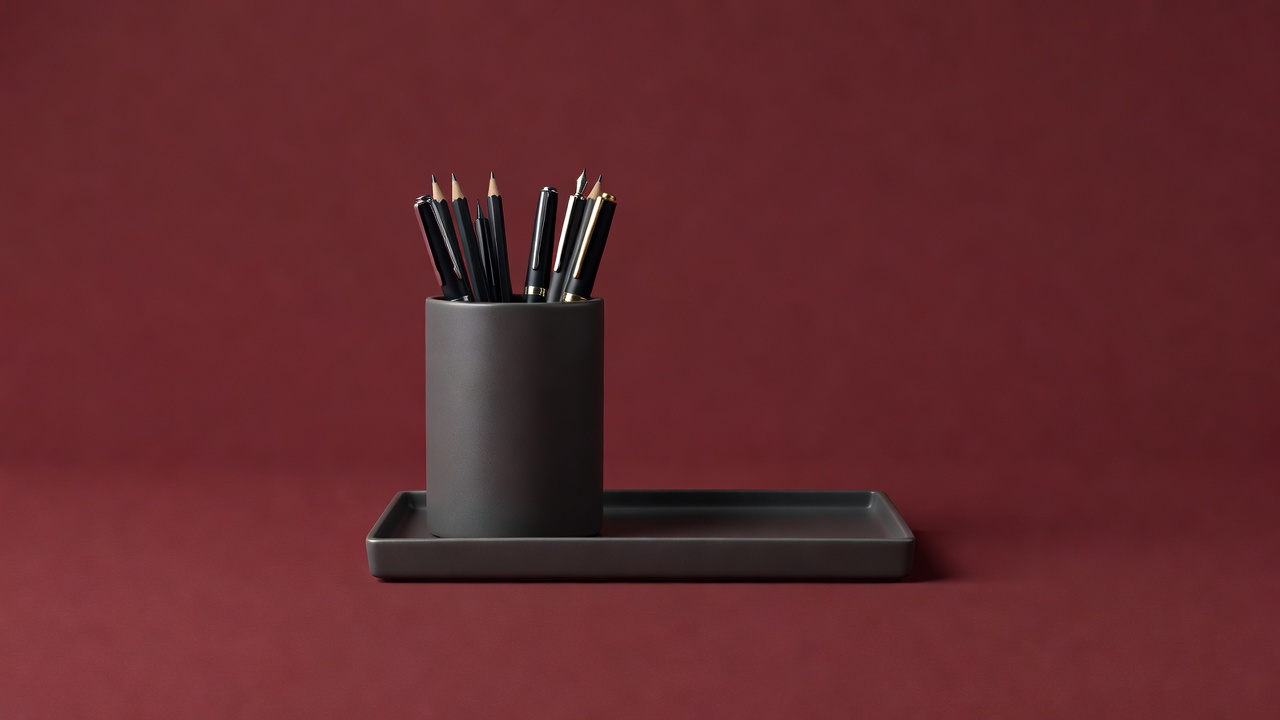
Order within arm's reach
A clear surface is not empty. It is arranged.
Think in reach zones
Before buying a single organiser, divide the desk by how often you reach for things. The near zone is the half-circle your forearms sweep without moving your shoulders. Keep only the keyboard, mouse, notebook and one pen there. The middle zone, a hand's stretch further, holds the lamp, a drink, and the things you use hourly. The far zone, the back edge and the space above, holds everything you touch once a day or less.
Organisers work when they follow these zones. A pen cup belongs at the edge of the middle zone, not in the centre of the near one. A tray for keys and earbuds belongs at the side, where you drop things when you sit down. If an object lives in the wrong zone, it will wander back to the wrong place within a week.
Cups, trays and mats
The pen cup
Choose a heavy base so it does not tip when you pull out a pencil. Ceramic, turned wood or anodised aluminium all work. Makers such as Grovemade have built a following for solid wood and metal desk pieces, while Muji offers plain, inexpensive acrylic and metal alternatives. Keep to five or six tools. Anything more is a stash, not a working set.
The catch-all tray
A shallow tray with a lip, in leather, felt or powder-coated steel, gives loose objects a boundary. It stops keys, cards and earbuds spreading across the surface.
The desk mat
A large felt or leather mat defines the work area, dampens keyboard noise and protects the surface from scratches. It also makes a quiet visual frame, so the desk looks tidy even with a few things on it.
Go vertical
The most underused part of any desk is the space above it. A shelf unit or monitor riser with a shelf beneath gives paper, books and a notebook a place to stand. A pegboard, such as the Ikea Skadis, turns the wall behind the desk into storage for headphones, scissors, a small plant and a clipboard. Hooks and shelves can be rearranged as your habits change, which fixed drawers cannot.
Under the desk, a shallow drawer unit or a clamp-on drawer slides into the dead space above your knees. Keep stationery, chargers and spare cables there, labelled and divided with small trays, so the surface stays free for work in progress.
Small spaces, student rooms
If your desk doubles as a dining table or sits in a shared room, aim for storage you can clear in one minute. A lidded box or a tray that holds your laptop, charger and notebook can be lifted and shelved at the end of the day. Fold-flat organisers and stackable trays save space when not in use.
- Choose one basket or box as your "end of day" container.
- Pick organisers in a single colour family, so the desk reads as calm even when full.
- Use adhesive hooks under a shelf for headphones and bags.
- Keep a small tray for the things that belong to the room, not the desk.
Keep it clear
Organisers do not solve clutter. Habits do. Adopt a one-in, one-out rule. Spend two minutes at the end of each working day returning everything to its zone. Once a month, empty each container and keep only what you actually used. If a tray has not been opened in a month, it is storage for storage's sake and can go.